PREVIOUS
2025 Disaster Season Exposes Fatal Weakness in Public Networks: First Responders Demand Independent Private LTE/5G Infrastructure



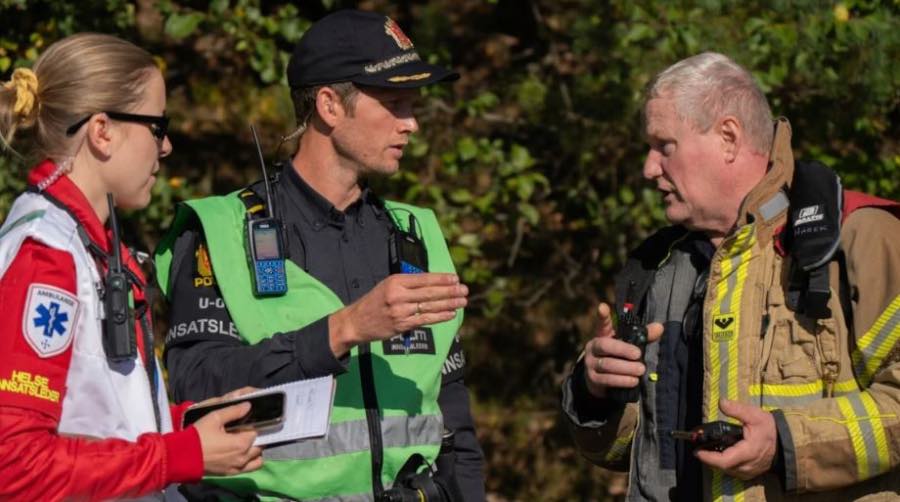
Ten years ago, Norway got its own dedicated network for emergency and preparedness communications. The emergency network has been one of the most important investments in public safety in Norway, and has linked all emergency and preparedness actors more closely together.
Nødnett is the national, digital radio link for efficient and secure communication between emergency services and other emergency response actors. It is used daily and in crisis situations by the three emergency services, the Norwegian Central Emergency Response Centre, volunteers, state administrators, municipalities and many other actors.
“Nødnett has given a significant boost to emergency preparedness in Norway. It is far more than a technical system. It is a common communications system that links emergency response actors more closely together,” says Eline Palm Paxal, department director for emergency and preparedness communication at DSB.
Before Nødnett, the emergency services each used their own analog radio systems. These were open to eavesdropping and had no way of communicating with other agencies. The police had their own communication system (police radio) that anyone could listen in to relatively easily. Nødnett replaced all of these with a nationwide, encrypted and eavesdropping-proof network with good control over who had access.
Nødnett is primarily used for conversations, either one-on-one or in predefined talk groups. In the talk groups, actors share information, gain a common situational picture, and can collaborate more effectively during missions.
On their way to an accident scene, all emergency services listen in on a common voice group. The first person to arrive at the accident scene gets a preliminary overview and shares important information with the others: What is the extent of the damage, which way should they go, where should they meet, is the area safe, is help from volunteers or a rescue helicopter needed?
“I am absolutely certain that Nødnett has helped save lives. When emergency services share the same situational picture, they can react faster and send in the right resources,” says Eline Palm Paxal.
Since its introduction, DSB has worked to further develop the system: The infrastructure has been improved and reinforced, capacity has been expanded and Nødnett has gained more and more users.
“With more users, we get better preparedness and crisis management. We meet and practice across the board, get to know each other and can work more effectively together when situations arise. For example, several grid companies have used Nødnett as an operational connection. This collaboration has made us better equipped to handle the consequences of power outages, as we experienced during storm Amy,” says Eline Palm Paxal.
She emphasizes that the importance of the Emergency Network has only increased since its introduction. Among other things, Norway, Sweden and Finland are the only countries in Europe that have cross-border communication and can communicate with each other across the emergency networks.
It simplifies cooperation between the countries, both at border crossings and during incidents. For example, Norway provided firefighters and helicopters when more than 60 forest fires raged in Sweden in 2018. Thanks to Nødnett, the Norwegian crews were able to cooperate with their Swedish colleagues on their own communications equipment, says Eline Palm Paxal.