PREVIOUS
FirstNet to Gain Over 1 Terabit-per-Second of Dedicated Satellite Capacity as ViaSat-3 F2 Nears Geostationary Orbit Over the Americas



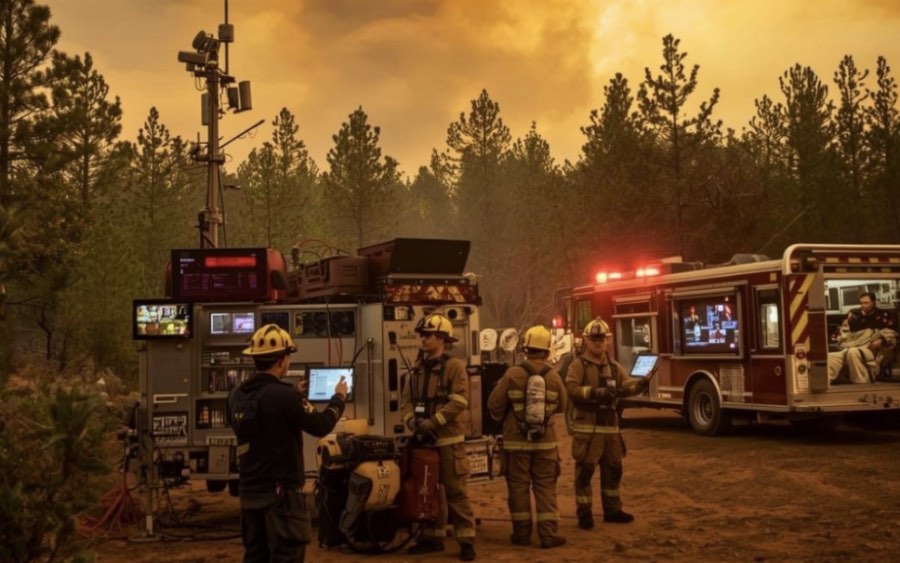
As the world reflects on an unprecedented year of natural disasters—from Hurricane Melissa’s devastating landfall in the Caribbean, to the explosive Southern California wildfires, the lingering aftermath of the Canada and Maui fires, the deadly earthquakes in Morocco and Turkey, and catastrophic flooding across Brazil—one inescapable conclusion has emerged: mission-critical operations can no longer rely on commercial cellular networks that collapse under crisis.
Time and again in 2025, public networks—designed for consumer convenience, not life-saving performance—failed precisely when they were needed most. Congestion, power loss, and physical damage to shared infrastructure left first responders, incident commanders, and affected communities disconnected during the critical first minutes and hours of response.
“These events have exposed a structural gap in our communications ecosystem,” said Alex Rivera, CEO of KYRO Technologies. “Public networks were never built to deliver the high-assurance connectivity that modern emergency response demands. When seconds count, borrowed bandwidth is not an option.”
The Definitive Shift to Independent Private LTE/5G Networks
Public safety agencies and critical infrastructure operators worldwide are now accelerating adoption of dedicated, independent private LTE and 5G networks that guarantee:
• Complete independence from commercial carrier congestion and outages
• Prioritized, congestion-free bandwidth reserved exclusively for mission-critical users
• Rapid deployment anywhere—urban, rural, or disaster-struck—in under 30 minutes
• Proven resilience in extreme heat, wind, flood, and seismic conditions
• A unified, secure backbone for real-time video, IoT sensors, drones, GIS mapping, and push-to-talk communications
KYRO: Purpose-Built for When Communications Cannot Fail
KYRO’s private LTE/5G platform was engineered from the ground up for the exact scenarios witnessed throughout 2025. Its fully independent architecture, ruggedized rapid-deployment nodes, and sovereign spectrum control deliver a network responders own and operate—one that remains operational when every public tower and fiber line has gone dark.
“KYRO doesn’t supplement public networks; it replaces the single point of failure they represent,” Rivera continued. “In the first 30 minutes of a disaster—when lives are saved or lost—communications must be engineered, not assumed.”
As climate-driven disasters grow more frequent, intense, and geographically unpredictable, the global public-safety community has reached a turning point. Private LTE/5G is no longer a future consideration or a luxury upgrade.
It is the new mandatory standard for mission-critical operations.