PREVIOUS
AT&T Extends FirstNet 5G Coverage Into Rural Pennsylvania With New Lock Haven Cell Site



Texas Tech University is expanding its national security capabilities with the opening of the Critical Infrastructure Telecom Ecosystem Incubator (CITEI), a new initiative focused on developing and testing technologies that strengthen the security and resilience of the nation’s critical infrastructure.
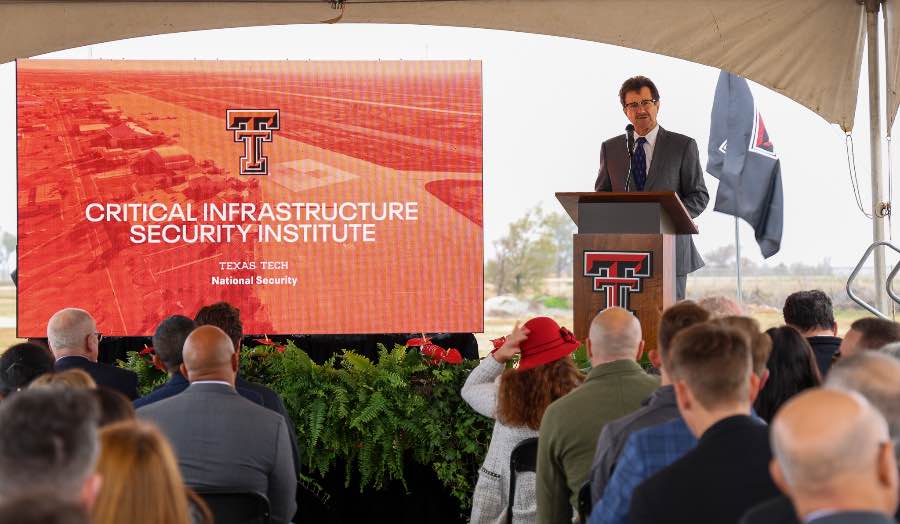
University officials and industry collaborators gathered Tuesday (Nov. 10) at the Texas Tech University Reese National Security Complex (RNSC) for a ribbon-cutting and demonstrations of technologies that could help detect potential threats, maintain communications during emergencies and improve connectivity in remote or challenging environments.
“CITEI brings together Texas Tech’s research expertise, the expansive full power capabilities at the RNSC and industry partners to address challenges in real-world conditions,” said Stephen Bayne, vice president for national security. “The Critical Infrastructure Security Institute (CISI) is advancing solutions that help operators detect threats, maintain communications and support national security priorities.”
Supported by the Texas University Fund (TUF), CITEI is led by Brenda Connor, senior technical director of the CISI and a professor of practice in the Department of Electrical & Computer Engineering in the Whitacre College of Engineering.
CITEI brings together Texas Tech researchers with AT&T and Nokia Federal Solutions to advance secure, reliable communications technologies for use in environments where traditional infrastructure may be limited, disrupted or vulnerable.
The research focuses on improving the ability of operators, leveraging AT&T expertise, to remotely monitor telecommunications critical infrastructure, identify potential threats and maintain essential communications while supporting the safety and effectiveness of personnel working in challenging conditions.
“The CITEI is both a system and an innovation team that includes Texas Tech collaboration with a tier 1 operator, AT&T, for telecom best practices and access to licensed spectrum and a world class telecom vendor, Nokia Federal Solutions, for a private cellular telecommunications network,” Connor said. “The ecosystem provides a real-world environment for innovative businesses, Valkyrie UAS Solutions and Taara, to exercise their capabilities. We are excited about the ability to accelerate value for our target customers.”
The demonstration at the event highlighted Nokia Federal Solutions’ Integrated Sensing and Communications (ISAC) for tactical and remote deployments, which uses artificial intelligence (AI) to strengthen situational awareness and operational efficiency for critical infrastructure, border security and defense applications.
Researchers also demonstrated how detection information could be shared with other systems to provide real-time situational awareness and support automated responses.
Researchers showed how advanced wireless communications technology can also be used to detect and track moving objects, including vehicles and unmanned aircraft. During testing, the system detected and tracked drones traveling more than 60 mph at altitudes exceeding 300 feet. The group 2 drones are operated by Valkyrie UAS Solutions, an active research collaborator with facilities at the RNSC.
In separate testing, the team demonstrated high-speed mmWave wireless communications over distances exceeding two miles, showing the potential to extend connectivity in remote or infrastructure-limited environments.
The team displayed how a private wireless network could provide connectivity for compatible AT&T and FirstNet devices, creating additional communications options for emergency responders and personnel working in remote or challenging environments.
This capability could be particularly valuable during disaster recovery, large-scale events, critical infrastructure operations and tactical deployments, where reliable communications are essential and traditional networks may be limited or unavailable.
Researchers also highlighted the potential of next-generation, free-space optical communications, a technology that transmits data using highly focused beams of light rather than traditional fiber-optic cables or radio signals.
The technology offers a high-capacity alternative for transmitting information between locations and could help organizations maintain connectivity when conventional communications infrastructure is disrupted or impractical to deploy.
Future research will examine how these systems can maintain reliable performance under adverse weather conditions, an important consideration for their use in emergency response, critical infrastructure and national security operations.
Through CITEI and CISI, Texas Tech is expanding research, testing and partnership opportunities focused on technologies that support the security and resilience of critical infrastructure and national defense.