PREVIOUS
Missouri Counties Deploy Tait P25 VHF Network With 95%+ Coverage



New Zealand’s SafetyNet Critical Communications is exploring the next generation of deployable public safety connectivity, testing a trailer-based cellular network solution alongside an emerging tethered drone communications platform.
The technology evaluation brought together representatives from across New Zealand’s public safety sector, including emergency services agencies and SafetyNet partners Hourua and One New Zealand, to examine how rapidly deployable network technologies could support responders when conventional communications infrastructure is unavailable, disrupted or unable to provide sufficient coverage.
At the centre of the exercise was a trailer-based Public Safety Network cellular deployable, which SafetyNet is evaluating as a potential complement to its existing compact deployable communications capability.
The larger trailer-based platform has the potential to extend coverage across a wider operational area and support a greater number of users. This could be particularly relevant to major incidents, natural disasters and large-scale search and rescue operations, where emergency personnel may need temporary communications infrastructure across geographically dispersed locations.
For public safety organisations, the ability to rapidly establish connectivity can be critical when fixed infrastructure is damaged, congested or simply does not extend into the area where responders are operating.
The demonstration also provided an opportunity to examine the role of aerial communications infrastructure.
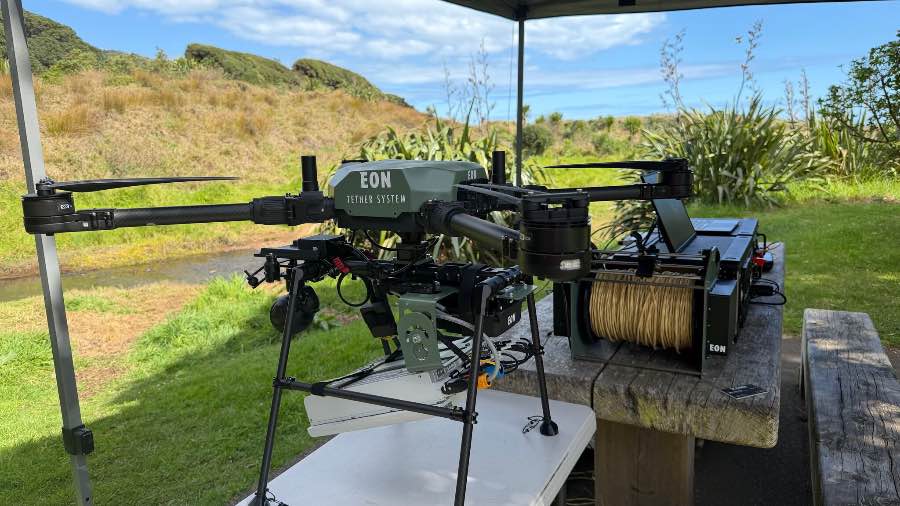
An XM2/Eonetics tethered drone equipped with Nokia telecommunications technology was showcased as an example of how elevated platforms could potentially complement terrestrial deployable networks.
Rather than replacing conventional infrastructure, tethered communications platforms can form another layer within a broader emergency communications architecture, providing an elevated network position that may help extend coverage in difficult terrain or temporary operational zones.
The approach is particularly relevant to scenarios where responders need connectivity beyond the footprint of existing infrastructure, including disaster response, remote operations and large-scale emergency deployments.
For SafetyNet, the exercise was not simply a technology demonstration. It provided an opportunity for public safety agencies, network operators, technology companies and subject-matter experts to assess emerging capabilities against real operational requirements.
That collaborative approach is becoming increasingly important as public safety communications evolve beyond traditional radio-centric infrastructure toward a combination of LMR, LTE/5G, MCX, deployable networks and non-terrestrial or aerial communications platforms.
New Zealand’s geography and exposure to natural hazards also create a distinctive environment for evaluating technologies that can be rapidly deployed and scaled according to operational requirements.
The SafetyNet trials highlight a broader direction within the mission-critical communications sector: connectivity is increasingly being treated as a flexible, deployable capability rather than something that depends entirely on permanent infrastructure.
Trailer-based cellular systems and tethered aerial platforms could form part of this emerging ecosystem, providing additional options for agencies that need to establish or restore communications quickly during major incidents.
For New Zealand’s public safety community, the value of such demonstrations ultimately lies in connecting emerging technology with operational realities — helping agencies understand where deployable cellular and aerial communications can complement existing networks and support responders when conventional connectivity is under pressure.