PREVIOUS
NO MORE



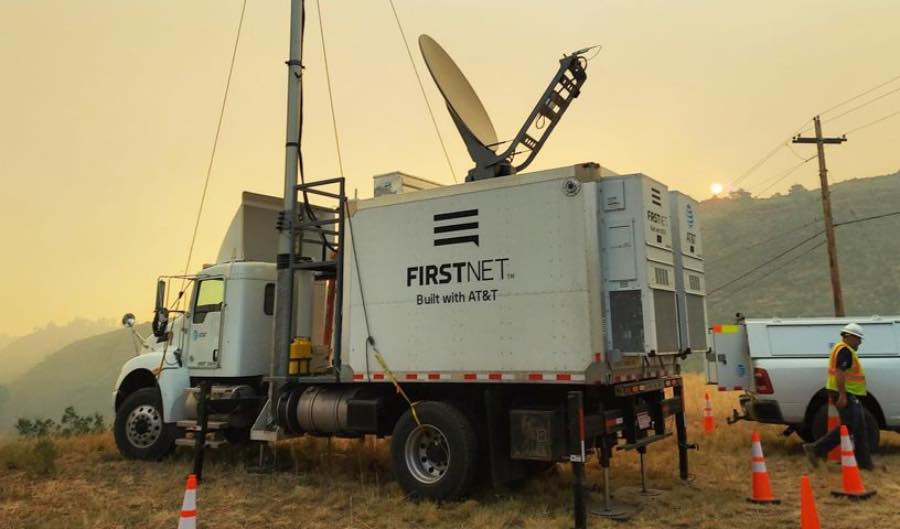
Coverage remains the defining challenge for public safety broadband in the United States, as first responders increasingly depend on 4G and 5G connectivity for mission-critical communications, video and situational awareness.
That message was made particularly visible at Vision 2026: FirstNet Users Summit, hosted by the Public Safety Broadband Technology Association (PSBTA), where approximately 430 public safety professionals gathered to discuss the evolution of FirstNet and next-generation emergency communications.
For the first time at the annual event, PSBTA placed a large U.S. map on display and invited attendees to identify locations where additional coverage is required. Participants could also submit written requests describing their connectivity needs.
PSBTA President Richard Carrizzo said the organization intends to provide the collected feedback to the First Responder Network Authority (FirstNet Authority) and AT&T, adding another layer of user-generated data to the existing process used to identify network expansion priorities.
“They have their own way. We're just providing a different type of data,” Carrizzo said.
The initiative highlights a fundamental reality of the U.S. Mission Critical Communications (MCX) market: despite major investment in public safety broadband, coverage remains the first requirement for responders operating in rural, remote and geographically challenging areas.
The FirstNet Authority has allocated $1.1 billion in its fiscal 2027 budget for network improvements and approved 220 new rural cell sites for AT&T based on public safety input.
Approximately 350 FirstNet sites are now in development, building on around 1,000 sites completed in 2025.
AT&T Assistant Vice President for FirstNet and NG911 Products Matt Walsh described the investment as significant, emphasizing that FirstNet-funded sites are incremental to AT&T's commercial network buildout.
A new 5G site in Horseshoe Beach, Florida, illustrates the impact of public safety-driven investment. Walsh said the location might not have justified a commercial deployment on its own, but feedback from public safety helped drive the decision to build the site.
For first responders, however, network expansion is not simply a question of infrastructure numbers. The requirement is operational availability when and where an emergency occurs.
Industry analyst Ken Rehbehn of CritComm Insights described FirstNet's overall progress as mixed, while acknowledging its importance in establishing public safety priority, quality of service and pre-emption within the U.S. wireless market.
As terrestrial coverage gaps remain, direct-to-device (D2D) satellite communications are gaining attention as a potential additional layer of resilience.
T-Mobile's T-Satellite, enabled through its Starlink partnership, is already available, while AT&T and Verizon are pursuing satellite broadband capabilities through partnerships with AST SpaceMobile.
AT&T is currently conducting D2D trials and has established four ground gateways. The company's longer-term objective is to extend connectivity to areas where terrestrial networks cannot provide service.
“Public safety is really excited about satellite,” Walsh said, adding that satellite could eventually provide voice and data connectivity where conventional network coverage is unavailable.
For public safety agencies, D2D is particularly significant because it could move satellite connectivity beyond temporary network infrastructure and provide connectivity directly to responder devices.
The summit also highlighted the broader evolution of public safety communications through FirstNet Fusion and AT&T's 5G standalone (5G SA) network capabilities.
Fusion is designed to bring together cellular broadband and land mobile radio (LMR) communications, supporting interoperability between different agencies and communication technologies.
Meanwhile, the 5G SA core is enabling higher uplink performance, supporting increasingly data-intensive public safety applications such as live video and real-time situational awareness.
Yet technology innovation ultimately faces one uncompromising requirement from the public safety community: it has to work when lives depend on it.
Carrizzo noted that while early adopters will embrace emerging technologies, the broader public safety market requires proven reliability before widespread deployment.
For FirstNet, T-Priority, Verizon Frontline and emerging satellite-enabled services, that expectation sets an exceptionally high benchmark: dependable connectivity 24 hours a day, 365 days a year.
The coverage map at Vision 2026 therefore represents more than a collection of pins. It is a clear signal from the U.S. public safety community that the next phase of broadband communications will be measured not simply by network speed or technology generation, but by where responders can connect when they need it most.