PREVIOUS
Nottinghamshire Police Selects NEC for Next-Generation Control Room



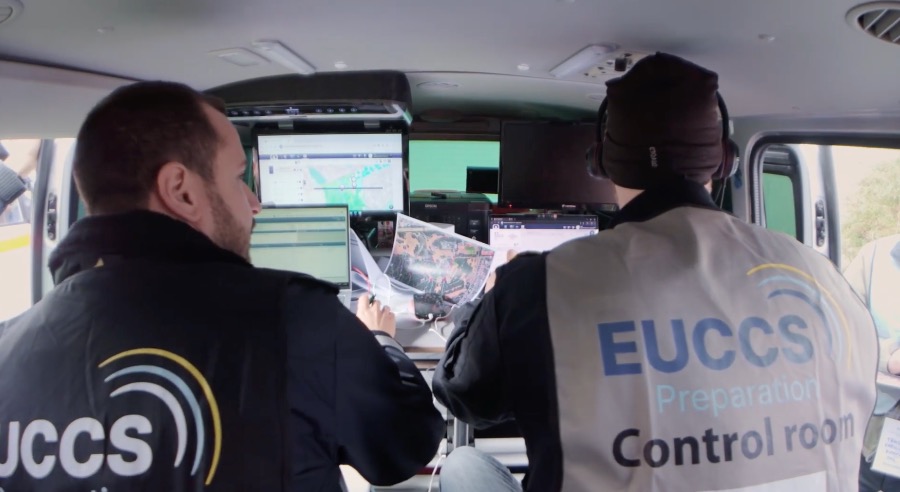
BRUSSELS/BUCHAREST — August 2026 — Cross-border cooperation, advanced data services and future-ready communications networks are becoming increasingly important to the effectiveness of mission-critical operations, according to Danut Codrici Mircea of Romania’s Special Telecommunications Service (STS) in the latest EUCCS video testimonial.
As emergency response becomes more complex and geographically interconnected, the ability of public safety organizations in neighboring countries to cooperate, share resources and exchange critical information can have a direct impact on response times and operational effectiveness.
“Two countries working together can share resources and make the response more effective. This will lead to a shorter response time to the emergency, and this is important,” said Danut Codrici Mircea, highlighting the operational value of cross-border cooperation.
The requirements of mission-critical users are also evolving beyond the traditional voice and messaging services historically delivered by professional mobile radio networks.
According to Danut, modern emergency responders increasingly require access to a broader range of real-time information, including location data, digital maps, video and images, alongside mission-critical voice and messaging.
These capabilities can provide responders with a more complete operational picture, helping them assess incidents more accurately and determine the most appropriate course of action.
The evolution reflects a broader industry transition toward Mission Critical Communications (MCC) and Mission Critical Services (MCX), where voice, data and multimedia communications are integrated into a unified operational environment.
The growing demand for richer information services is also creating new responsibilities for network service providers. Networks supporting public safety and other mission-critical users must evolve to accommodate increasingly sophisticated applications while maintaining the reliability, availability and performance expected from critical communications infrastructure.
“From the network service provider's side, we need to adapt our networks to support the features needed by users. We also need to develop the networks to be prepared for the future, and for the future needs of mission-critical users,” Danut said.
This future-oriented approach is particularly relevant as the communications industry moves toward 4G, 5G, Mission Critical Push-to-Talk (MCPTT), Mission Critical Data (MCData), Mission Critical Video (MCVideo) and broader MCX ecosystems.
For public safety organizations, the objective is not simply to introduce new communications technologies, but to ensure that next-generation networks can deliver actionable information when and where it is needed most.
The EUCCS testimonial also underscores the importance of interoperability in European emergency communications. When incidents cross national or organizational boundaries, the ability to coordinate personnel, share resources and exchange real-time situational information can become a critical component of the emergency response.
The continued development of interoperable mission-critical communications therefore represents an important step toward creating more connected and resilient emergency-response capabilities across Europe.
Danut Codrici Mircea's contribution to the EUCCS video series highlights a clear industry direction: mission-critical communications are moving from traditional voice-centric networks toward integrated, data-rich and interoperable communication ecosystems designed around the evolving needs of emergency responders.
As these requirements continue to develop, network operators, technology providers and public safety organizations will need to work together to ensure that future communications infrastructure is capable of supporting the next generation of mission-critical operations.
Source: EUCCS — Video #9 featuring Danut Codrici Mircea, Special Telecommunications Service, Romania.