PREVIOUS
NO MORE



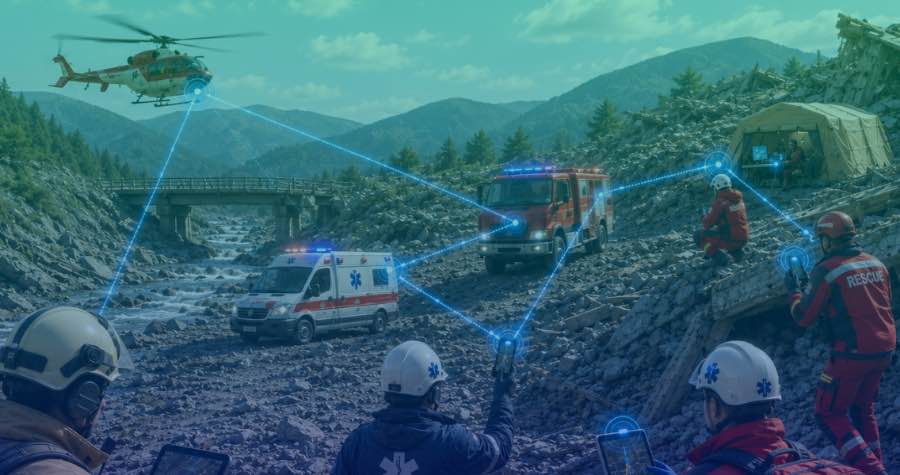
The European Telecommunications Standards Institute (ETSI), with the support of the Critical Communications Association (TCCA), is advancing the development of network-independent Mission Critical Services (MCX) through its first dedicated MCX Off-Network Plugtests™ programme.
Taking place at ETSI headquarters in Sophia Antipolis, France, the initiative brings together technology vendors, network operators, infrastructure providers and public safety stakeholders to evaluate the interoperability and practical performance of MCX solutions in off-network environments.
As mission-critical communications continue to evolve towards 3GPP-standardised broadband services, ensuring connectivity beyond conventional network coverage is becoming an increasingly important requirement. The first MCX Off-Network Plugtests addresses this challenge by focusing on direct device-to-device communications, enabling users to maintain essential communication capabilities when cellular network infrastructure is unavailable.
The testing programme is designed to validate the applicability, completeness and interoperability of relevant 3GPP MCX specifications under off-network conditions. It places particular emphasis on direct device-to-device (D2D) communication, allowing mission-critical users to exchange information without relying on conventional cellular network infrastructure.
The technical scope covers three key areas:
Mission Critical Services (MCS) Clients: Testing MCPTT, MCData and MCVideo capabilities in direct communication scenarios.
MCS Common Services Core: Evaluating common services functionality, including support for CSC-11 and CSC-12.
5G NR Sidelink Devices: Assessing direct communication capabilities based on 5G New Radio (NR) sidelink technology.
Based on relevant 3GPP, ETSI and IETF standards, the test scenarios are intended to evaluate implementation behaviour, identify interoperability challenges and investigate how solutions from different vendors operate together in network-independent environments.
Off-network communications represent a critical component of next-generation mission-critical broadband services. During major emergencies, natural disasters, infrastructure failures or operations in remote and isolated locations, public safety agencies may encounter situations where conventional mobile network coverage is unavailable or disrupted.
In such circumstances, direct device-to-device communications can provide an alternative means of maintaining operational connectivity between field personnel. The ability to support voice, data and video communications independently of network infrastructure is therefore an important consideration in the evolution of 3GPP MCX technologies.
Through multi-vendor testing, ETSI aims to identify implementation gaps, improve technical alignment across the industry and strengthen confidence in the interoperability of off-network MCX solutions.
The initiative also provides participating organisations with opportunities to debug implementations under realistic scenarios, assess performance in coverage-limited environments and contribute to the further maturity of the MCX ecosystem.
Alongside the technical testing, the programme includes an onsite round-table discussion focusing on the deployment challenges associated with Mission Critical Off-Network communications.
Industry observers, including government organisations, mobile network operators, public safety agencies, regulators and other stakeholders, are invited to contribute to defining testing priorities and reviewing test statistics through ETSI's Test Reporting Tool (TRT).
The first MCX Off-Network Plugtests is co-funded by the European Union (EU) and the European Free Trade Association (EFTA), reflecting the broader European commitment to advancing interoperable and standards-based mission-critical communications.
Running from 3 to 6 November 2026 at ETSI headquarters in Sophia Antipolis, France, the inaugural MCX Off-Network Plugtests marks an important step towards validating the next generation of network-independent mission-critical broadband communications. Its outcomes are expected to contribute to ongoing industry collaboration and the continued development of interoperable 3GPP MCX solutions for public safety and other mission-critical sectors.