PREVIOUS
L3Harris Wins $20M NFTA Contract to Upgrade Buffalo Critical Communications Network



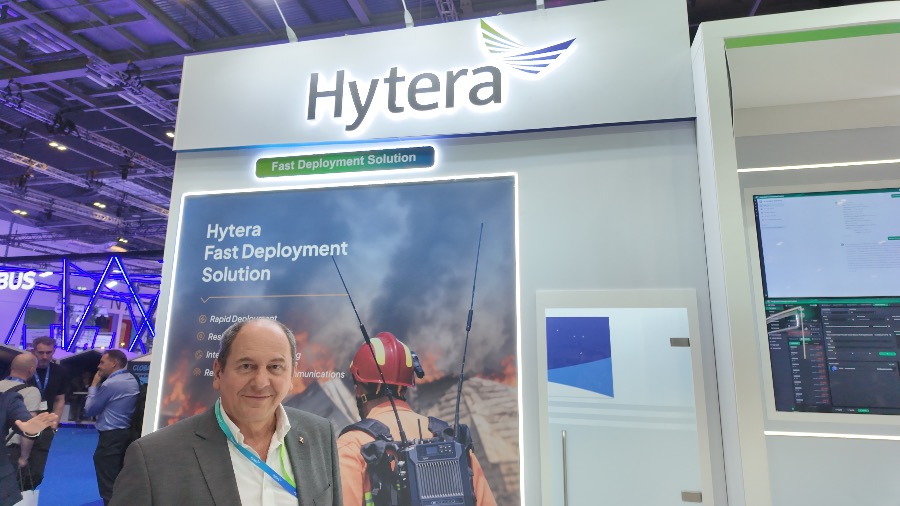
LONDON, UK — Critical Communications World (CCW) 2026 — As the mission-critical communications industry continues its transition from standalone radio networks to integrated broadband ecosystems, organizations are increasingly seeking complete operational solutions rather than individual technologies. During an exclusive interview with MCXTEND and Comunicaciones Críticas at Critical Communications World (CCW) 2026, Michael Zwingl from Hytera Europe has shared insights into how the industry is evolving toward converged mission-critical communications platforms that combine narrowband, broadband, intelligent command centers, and artificial intelligence.
According to Michael Zwingl, the future of critical communications is no longer defined by individual products but by the ability to deliver end-to-end operational ecosystems that support decision-makers, frontline personnel, and control room operators across multiple sectors.
"It's basically not about products; it's about solutions," Michael Zwingl explained during the interview. "What we want to demonstrate is how our knowledge and technologies come together to form an ecosystem that delivers value to all stakeholders involved in critical operations."
Beyond Devices: Building a Complete Mission-Critical Ecosystem
At CCW 2026, Hytera showcased a comprehensive portfolio spanning traditional narrowband radio systems, network infrastructure, mission-critical broadband solutions, MCX servers, mobile device management platforms, and next-generation user devices.
The integrated approach reflects a broader market trend as organizations increasingly seek seamless interoperability between legacy land mobile radio (LMR) systems and broadband mission-critical communications technologies.
Michael Zwingl emphasized that customers today require a unified communications environment capable of supporting mission-critical voice, data, video, and operational workflows under the most demanding circumstances.
Hytera's latest MCX devices attracted significant industry attention during the event, with one of its solutions receiving an industry award during CCW 2026. The recognition highlights growing market acceptance of standards-based MCX technologies as organizations accelerate their migration toward broadband-enabled critical communications.
Standards Compliance Remains Critical
As public safety agencies, transportation operators, and industrial enterprises evaluate next-generation communications investments, adherence to international standards continues to be a key requirement.
Michael Zwingl highlighted the importance of supporting 3GPP Mission Critical Push-to-Talk (MCPTT) and related MCX standards to ensure interoperability, scalability, and long-term investment protection.
Industry stakeholders increasingly recognize that open standards are essential for enabling multi-vendor ecosystems and supporting future technology evolution without compromising operational reliability.
Serving Diverse Critical Industries
One of the key themes emerging from the interview was the broad applicability of mission-critical communications technologies across different vertical sectors.
From public transportation networks and industrial operations to emergency services organizations, customers share a common operational requirement: reliable access to real-time information that enables rapid and accurate decision-making.
"The common denominator across all these sectors is trust," Michael Zwingl noted. "Users need communications systems they can rely on, and they need access to information that helps them make the right decisions quickly."
This convergence of operational requirements is driving increased adoption of integrated mission-critical communications platforms capable of supporting multiple user groups and operational scenarios within a single environment.
AI-Powered Command Centers Take Center Stage
Perhaps the most significant trend discussed during the interview was the growing role of artificial intelligence within mission-critical command and control environments.
Michael Zwingl described Hytera's Intelligent Command Center concept, which leverages AI technologies to assist operators during high-pressure incident management scenarios.
By aggregating operational data, analyzing incoming information, and supporting situational awareness, AI can help command center personnel make faster and more informed decisions while reducing the impact of human stress and emotional pressure during critical incidents.
According to Michael Zwingl, AI serves as a decision-support tool rather than a replacement for human expertise, providing objective information that enables operators to respond more effectively during emergencies.
As public safety agencies and critical infrastructure operators continue to modernize their command and control environments, AI-enhanced operational support is emerging as a key differentiator in next-generation mission-critical solutions.
Award-Winning MCX Deployments Demonstrate Market Momentum
In addition to product recognition,Hytera also received industry recognition for a major MCX deployment in Asia's transportation sector.
The award-winning project highlights the increasing maturity of mission-critical broadband technologies within large-scale transportation environments, including rail networks, airports, and other complex operational infrastructures.
Transportation operators worldwide are increasingly adopting MCX platforms to improve workforce coordination, operational efficiency, safety management, and real-time communications across geographically dispersed assets.
The recognition further underscores the growing role of broadband mission-critical communications as organizations pursue digital transformation strategies while maintaining the reliability traditionally associated with narrowband radio systems.
Industry Outlook
The insights shared by Michael Zwingl reflect a broader transformation occurring across the mission-critical communications sector. As organizations move beyond standalone radio networks, the industry is increasingly focused on integrated ecosystems that combine LMR, MCX, AI-enabled command and control, and standards-based interoperability.
For public safety agencies, transportation operators, and industrial enterprises alike, the goal remains consistent: delivering reliable communications and actionable information that enable faster, safer, and more effective operational decisions when they matter most.
As demonstrated at CCW 2026, the future of critical communications will be defined not by individual technologies, but by how seamlessly they work together to support mission-critical operations.